

It’s Heather This isn’t the kind of post I typically write, but no book has ever prompted so many people to reach out to me and say, “You have to read this book.” If you have no interest in my armchair commentary, please forgive me and don’t unsubscribe from The Joint Account :) But if you love to read as much as I do and have been caught in the buzz around this memoir, you’re in for some hot takes and a long read. Thanks for being here.
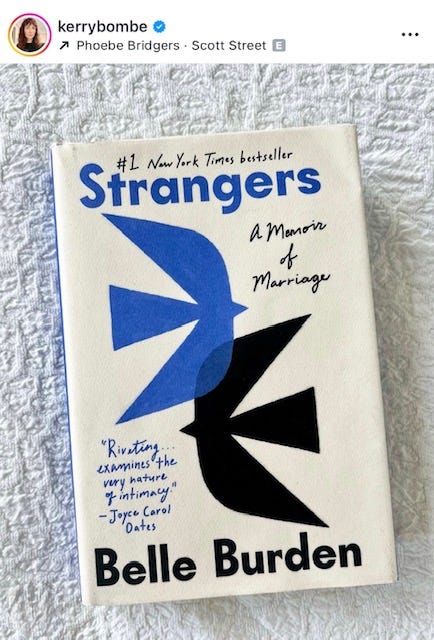
Strangers: A Memoir of Marriage is Belle Burden’s deeply personal account of the unraveling of her two-decade marriage. Set in the early days of the pandemic, her memoir begins with the jarring revelation that her hedge fund husband is having an affair and leaving her. What follows is a painful autopsy of her family history, her relationship, and her willingness to be subsumed financially and emotionally by someone else.
The book became an instant bestseller, and supposedly, Gwneyth Paltrow will star in and executive produce the film adaptation. But it’s also drawn mixed attention online. The writer circles I float in seem angry that a debut author of incredible privilege gets the chance to have her story told (one writer I follow refers to Burden as part of the “Epstein class”). My lawyer friends are hyper-fixated on the prenuptial agreement that should have never been changed. Others have expressed grievances ranging from anger at her family’s behaviors in the early days of the pandemic, to disdain for how a corporate lawyer could allow this to happen to herself, to disbelief that she was really that blind to her ex-husband’s true colors. I don’t know. I noticed some of these things, too, but they weren’t what I came away with.
What struck me most about Strangers wasn’t the unraveling of a marriage but how so many of the dynamics we wrote about in Money Together could happen to one person. It’s an example of how financial betrayal can happen at every income level, and even someone with the utmost privilege can make costly mistakes that are incredibly painful to recover from.
To accept what I am offering as the evergreen lessons from Burden’s life, you do need to possess a certain kind of empathy. Our book begins with the concept that “your story is your story,” meaning that not a single human on the planet—not even your sibling or your spouse—has lived your life. The way you perceive what has happened to you drives the way you feel and the decisions you make.
You may not like that Burden’s version of pain seems less painful than your version of pain, but we could play that game forever. We interviewed couples with an eight-figure net worth and couples who have needed government assistance, and you’d be shocked by the parallel themes underlying their conflicts over money: identity, legacy, trust, and freedom. But when you—as a reader, friend, or spouse—hold yourself out as the arbiter of who is allowed to feel what, you’re stripping yourself of an opportunity to view life through another lens and gain context for an experience or relationship you may not fully understand.
To me, Belle’s decisions were clearly influenced by where she came from. The granddaughter of Babe and William Paley, the daughter of Carter Burden, and a descendant of the Vanderbilts, Belle is New York royalty. It’s true. In her early days with James (as she calls him in the book), she pondered the long shadows of these famous names and the type of family structure she wanted to build for herself; but ironically, she built something similar to what she observed. So did James. I’ve been told by family therapists that people either run in the opposite direction from their parents’ dynamics, or they repeat them. Sometimes, they think they’re running, and they end up becoming.
The wealth disparity between Belle and James plays an unspoken role in their relationship. She all but admits that using her trust funds to purchase their communal properties felt like a demonstration of her commitment to their shared future. Perhaps she carried a layer of guilt around how they each respectively came into having what they had. Perhaps he carried a sense of distrust around marrying into generational wealth, and that’s why he insisted they keep their marital earnings separate. In the end, there is a sense that he believed, rather callously, that she’d be just fine no matter what.
The reader doesn’t know what he was thinking, and I’m not sure she knows, either. Discussions around money, privilege, and family wealth are hard to put words to, because in some ways, they are larger than us. They are the whispers of loved ones we can’t speak to anymore. They are voices that tell us what—and who—will be enough.
When it came to work, Belle’s decision to step away from her law career felt eerily relatable to me. As she wove through details of her demanding job, I recalled my own experience as a young woman in private practice, feeling like I’d lost agency over my own life in service of something I never intended my career to become. When the tide pulls you under, you fantasize about getting away however you can, even if it means becoming financially dependent on someone else. Foregoing a paycheck wasn’t an option for me, but I can’t tell you that I didn’t dream of it. It’s quite ironic, considering how hard I fought to keep my career as a young mother. But these competing feelings are tragically normal for women left unsure of whether the unsustainable conditions we face are conditions of our own making—as we are often told—or symptoms of systems meant to push women out of important conversations in every area of their lives.
Stepping away from the workforce for a season of caregiving is nothing to look down on. But ceding control to your high-earning spouse with no visibility into your finances is a risk too many women are willing to take.
“I guess I just trust him,” they would say to me in interviews, as if one person’s trust of another could answer for every what if. Trust is not why women disengage from their finances. They disengage because they are either made to feel like it isn’t their place, or because they are responsible for so much more of the physical, mental, and emotional load of carrying their family that money feels like the only thing they don’t need to do. In Burden’s case, it seemed to be both.
The cadence she fell into is common for any household with enough financial stability. People can fall into a “things are good” trap. They don’t think they need to know the details, because they believe they know enough to know that things are good. We live in a nice home. We go on vacations. Our kids can participate in all the camps and activities they want. My partner and I will keep doing everything the same, and everything will stay the same—or get better.
There’s comfort in that lie.
Burden enjoyed the comfort of operating within the echo chamber of her life as it stood. She cared for their children, their homes, their social plans, and their oversized dog. She didn’t ask questions about the money or how James spent his time, because things were good. In falling into the trap, she stepped back from her most important role of all: being her own person.
When people ask which chapter in Money Together makes me the most emotional, I tell them about the first in our section on power: Our Tiny Rebellions. Coming out of the pandemic, I had realized that my desire to magnify joy in little nothings was to cope with the fact that I was too afraid to ask for what I wanted. I wasn’t appreciating the small things—I had actively made myself small.
Before you try to address the power dynamics in your relationship, ask yourself this: how empowered are you? How much time, attention, and effort have you put into identifying your values and goals as an individual? You cannot just view power as mine or yours. The whole of two empowered partners is greater than what one person could do alone.
Burden deferred to how James liked their homes to look. She adopted his tastes. She got lost in the sauce of her husband and kids. For many women, the easiest thing to do is to live a life in service of everyone but yourself. Sticking your neck out feels like too great a risk. Not when “things are good.” This is how you end up making a sandwich for the man who just asked you for a divorce: because you truly don’t know what else to do.
To me, the most heartbreaking moment in Strangers came with Burden’s use of a word that Douglas and I are so adamantly trying to redefine. She said, “It is what he made clear within weeks of leaving, that he believed my contributions to his career, to our family, over twenty years, amounted to nothing.”
What does it mean to contribute? Our society has viewed this word with too tight a lens, focusing too much on who produces and not enough on how we provide. We contribute in more ways than earning money. We contribute with our care. With our time. With our love. When your partner doesn’t see that, it can feel like the most devastating blow of all.
Following the low of this realization, Burden unwinds her financial affairs from James and begins looking for footing to stand on her own. This honest and vulnerable story was hers, and I think there’s much to gain from reading it. In the end, she starts see what we hope our readers, and all of you, will see. She wrote:
“Slowly, over many months, as my head came out of the sand, a form of joy set in—joy born of replacing the not knowing with knowing, the nub of worry with clarity, the lack of control with control. All made easier, of course, by the fact that I had enough to feel secure, to make my children secure. I thought, This is better than everything I lost. This is better than the life I thought I wanted.”
Knowing will always feel better than not knowing. When it’s all said and done, facts are always better than selling ourselves fiction.
I need to know if you’ve read Strangers. What did you think? Let’s chat.
You Up?
You up? Good, because we’ve got a question for you. This new mini-series mixes prompts from Money Together with fresh ones we’ve been thinking about, all designed to spark real, honest money conversations with your partner. Here’s a doozy:
Do you feel free to spend?
Money Together x Wyndham Hotels!

We such a great time hosting a virtual session on Money Together with the incredible team at Wyndham Hotels & Resorts this week. Doug I brought our no-filter conversation about how couples can communicate better, align on values, and build a stronger financial life together. These are the kinds of discussions that galvanize the power of your voice at home and at work. Thank you to everyone at Wyndham for making this happen and showing up in numbers!
If you’re part of an organization looking to bring meaningful financial wellness to your employees, we’d love to chat.
Friendly reminder to our free subscribers: all new posts arrive in your inbox. After 14 days, they will be placed behind a paywall on our site. If you love The Joint Account and want complete access to our archives, a monthly AMA with us, bonus video content, and more, please consider becoming a paid subscriber.

Money Together is here. If you find value in our newsletter and want to support our work, please order a copy today: Amazon, Barnes & Noble, Bookshop, or Audible (narrated by Heather!).
Love it already? PLEASE, PRETTY PLEASE leave us a review on Goodreads and wherever you purchased.
Want more Heather and Doug? Have us come talk about love and money with your organization—virtually or IRL. Reach us here.
Connect with us on social: @averagejoelle + @dougboneparth
The content shared in The Joint Account does not constitute financial, legal, or any other professional advice. Readers should consult with their respective professionals for specific advice tailored to their situation. The information contained in this post is general in nature and for informational purposes only. It should not be considered as investment advice or as a recommendation of any particular strategy or investment product. This post is not a solicitation or an offer to buy or sell any specific security. Bone Fide Wealth cannot guarantee the accuracy of information from third parties.
I read the book as I read divorce memoirs as a genre. I could not get over that prenup. Like, how in the heck did she sign it? And then, when she quit working, why didn't she get a postnup? Because the idea that he would keep all his earnings as she provided the cushion for him to be able to work unheeded was just astonishing to me. But again, she presumed his good graces and she had plenty. But wowza. A costly mistake. I mean, I made many of the same mistakes, in other words, ceding all financial matters to my ex-husband and then being shocked in the financial disclosures process. It was a horrible feeling.
I read the book and share many of your thoughts as well. Working in financial services I was so grateful for her vulnerability in sharing the details of the career and financial choices she made, and the impact of those decisions once he left. I wish more women would be willing to share this type of wisdom with each other. We can have all the facts in the world, but it’s stories like this that shape us.