

Heather here, reporting to you live from Future Proof, the world’s only wealth festival on the beach! We’ve spent the past few days catching up with colleagues in sunny SoCal, but I didn’t want to hold out on you any longer with this back-to-school survival guide that helped me through on one of my biggest (and most surprising) challenges as a parent in quite some time.
Those of you who have been around here a while know, I love to shop. It’s basically genetic—I consider myself a fourth-generation patron of the retail arts. I shop for everyone in my family. I’ve taken friends on the fashion equivalent of pizza walking tours. I’ve elbowed strangers over Tory Burch boots in a second-story warehouse on Seventh Avenue (in 2008, ofc). I’ve woken at midnight for limited-time Target collabs and fielded emergency texts about looks for job interviews and red carpets and 20th high school reunions. It’s fine. I love it all.
But shopping for my 10-year-old daughter is perhaps my greatest shopping challenge of all time.
These are the kinds of problems you don’t see coming until they are here. You’re going about your usual course of business, picking up a new pair of leggings here, some swimsuits for camp there. As a mom, you know the places you like to buy clothes for your kids, and you do as you need. Up the size charts you go: 4, 6x, 7/8, small, medium, large. In the wise words of a band from my own tween years, “Every new beginning comes from some other beginning’s end.” Until they don’t.
One day, you are propelled into an alt universe that’s neither here nor there. It’s like a vortex of confusion and emotion and money where very little is right and very much is wrong.
The first issue is that tween girls are in an interesting moment in their lives. They’re suddenly more self-aware and beginning to figure out how they want to present themselves to their peers, but most of them don’t really have a personal style yet. How could they? There’s such a wide range of cultural awareness at this age. Early adopters of social media have the internet’s top trends fused into their brains. Other girls have older sisters feeding them intel. Some have sensory issues and/or very distinct preferences. Many have been completely aloof and are just realizing style exists for the first time in their lives.
Then there’s fit, which is the biggest practical issue. Tween bodies are constantly changing, and it’s astonishing how few brands are designed to accommodate them. When you need more width, you get more length. I don’t want to pay a tailor for something that might not fit in four months. Again, we are neither here nor there. Nothing is right. Everything is wrong.
Tweens don’t want to look like their little sisters or their mothers. I don’t blame them. But where that leaves us is a tough middle ground. Ironically, some of the skimpier young women’s brands for shorts and tops fit tweens at respectable lengths, but then, we’ve opened new doors. Are we ready to shop at those stores?
And finally, we have to wrestle with the price tag.
When you shop for a 10-year-old girl in adult stores, you’re contending with adult prices. And it’s no longer just a pair of pants here or there. It’s the whole damn wardrobe. I can’t explain it, but it feels like I’m starting from scratch with every season. We just survived Back to School shopping, and I don’t recall spending this much time or money on Hazel since I was pregnant with her.
Because of the first two problems—style and fit—it becomes a very slippery slope. You finally find a store where things fit and she loves how she looks, and suddenly you’re standing outside the dressing room like Kris Jenner with a camcorder and a Black card exclaiming, “You’re doing great, sweetie!” without any regard for the fact that merely two years ago, you would shake your head at a fifth grader wearing Lululemon. But here you are, no different than the new moms who said they’d never let their babies play on their phones, because they’ve never gone on vacation and had to bring an exhausted six-year-old to an 8pm family dinner reservation.
Never say never, friends. You don’t know until you know.
But this is not a long-term strategy. For one thing, it can blow your clothing spend completely out of the water. More importantly, this is a moment where you can lose a lot of ground when it comes to teaching your kids about money and how you choose to spend it in the real world.
I don’t want to teach my daughter that life one giant shopping spree, but I also don’t want to infuse her with scarcity and make her feel bad because she genuinely needs an entire new wardrobe. Growing is NEVER something I want her to feel bad about.
However, I want her to understand that these clothes cost real money and that different purchases deserve different levels of consideration. Shopping at Old Navy is not the same as shopping at Aritzia. If something costs a lot more, she should know, she should really like it, and she should commit to wearing it.
Thankfully, I’m not putting together a plan from scratch.
Two years ago, I wrote a piece called Steal, Staple, Splurge about the shopping strategy I use for myself. I came up with it because I needed a way to avoid both ends of the pendulum in my own shopping behavior: overspending on shiny and impractical things (i.e., dopamine spending), or getting so overwhelmed by prices that I shut down and buy nothing (my old scarcity mindset rearing its head). I called it a strategy rather than a budget, because I wanted a framework that would empower me to move through old habits rather than assign a blanket numeric cap that would risk leaving me without things I needed.
I assigned items to three categories: steals, staples, and splurges. This way, I already had a mental range for how much I’d spend on certain items before I even started shopping. For example, blazers and jackets need to fit well—they are my splurges. Athletic tops stain and get gross—they should be steals. As you can see, this isn’t really a game of “yes” or “no.” It’s about deciding where quality, visibility, and cost matter to me most.
As I felt the vortex of tween shopping pushing me into panic mode, I remembered the framework. Though it’s not a perfect science, and items definitely needed some reconfiguring into new buckets, I feel more empowered knowing I have a plan I can stick to when we head to the mall or I’m slogging through a website of fast fashion during their BTS sale. Hopefully, this can help some of you in the same boat as me.

STEAL
Steals are the flings. You have very little expectation that they’re going to survive for the long haul, and they don’t need to. For a tween, I look for steals when the item itself has a short shelf life, either because she’ll outgrow it quickly, it will get destroyed, or the trend will be gone by next season.
This is also where I put things that take a beating regardless of how you treat them. Tank tops get stained and sweaty. Swimsuits encounter chlorine, sunscreen, and rough pool decks. Dress shoes get worn three times before they’re too small. Sweatpants drag the ground everywhere, and fit doesn’t need to be perfect for them to work.
Right now, our steals include: tank tops, sweatpants, swimsuits, dress shoes, and hyper-trendy anything (what bows were to 2026 and cherries were to 2025).
STAPLE
As I wrote in my original piece, staples should be the things you can build around. This is where fit, comfort, and durability matter. You know what you’re getting. You know you’ll use them. You may even go back and buy another color because they’ve already proven their value.
For tweens, this category is especially important, because bodies change quickly and because of that, self-consciousness can show up without warning. So, when we find bottoms that fit properly and can survive the wash, I am much less interested in finding the absolute lowest possible price. I still love a sale, obviously, but this is where I am willing to pay more for something that works.
Right now, our staples include: jeans, athletic leggings, athletic shorts, basic tees, and hoodies, which don’t need to fit perfectly to get many seasons of use.
SPLURGE
Believe it or not, splurges have a place in here, too. Given the fleeting nature of our tweens’ needs, I understand how this category might seem to not make sense, but hear me out.
I’ve always believed splurges should be visible, frequently used, relatively timeless, or attached to something meaningful. A nearly identical item you can buy generic for substantially less probably isn’t worth the splurge. Something that gets used constantly, performs better, marks a special occasion, or makes you feel incredible might be.
My daughter carries her backpack through an entire school year. Her everyday sneakers get hundreds of wears. And when it comes to dresses or special-occasion outfits, sometimes clothes are part of the milestone. In the same way I get excited to pick out a special outfit for a special day, I love being a part of helping her do that, too.
Right now, our splurges include: winter jackets, backpacks, everyday sneakers, dresses, and special-occasion outfits.
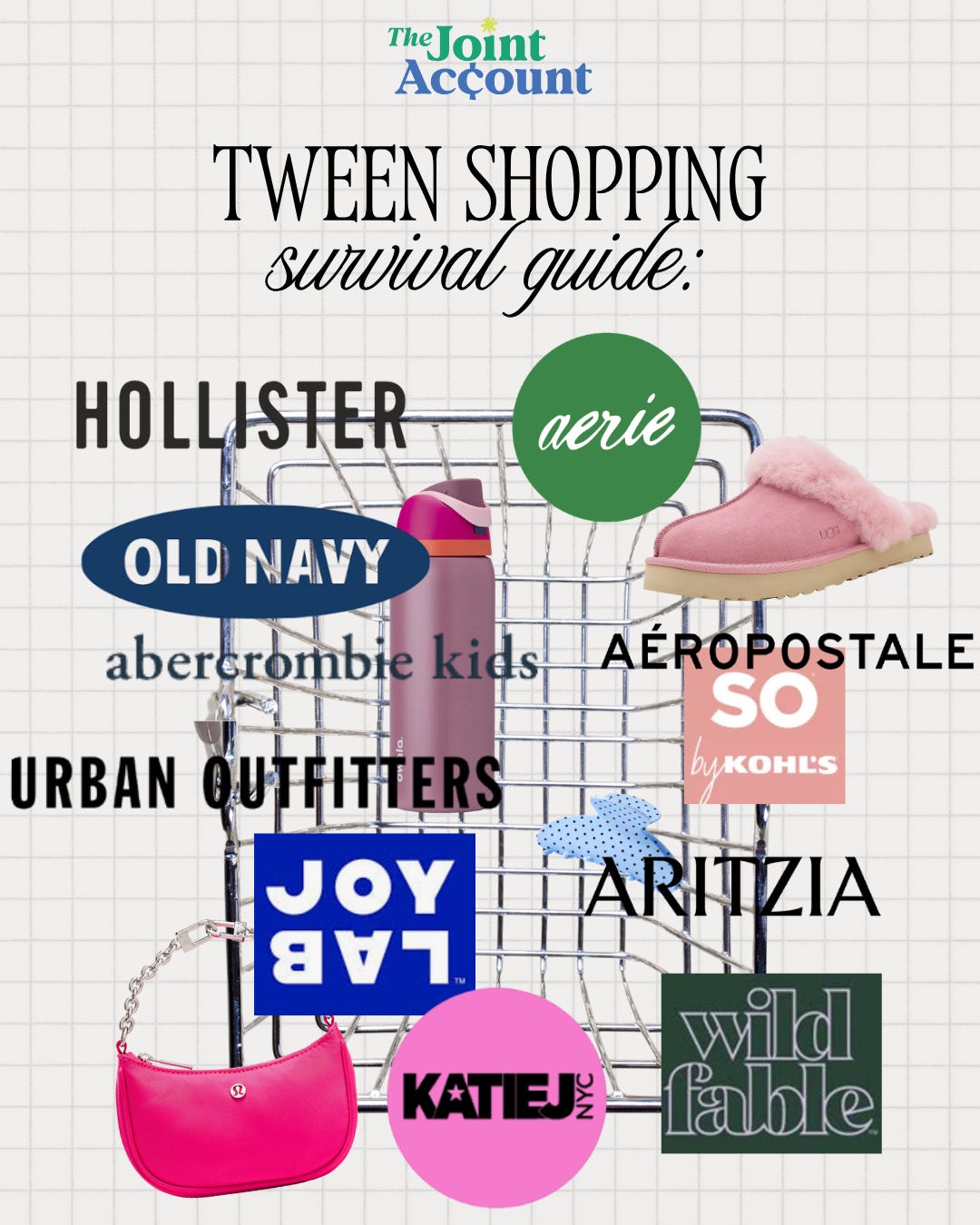
Leading up to this piece, I’ve had chats with many of you about the brands that are and aren’t working for us right now. Here’s just some of the places that everyone’s having success:
Will I violate my own framework? I’m sure I will. I am a consumer, not a saint.
But like any area of your personal finances, the point here is to have a plan to lean on when the circumstances start making you feel irrational or out of control. And same as ever, the money behaviors we display before our kids are the messages they hold onto.
If we’re lucky, we’re creating some good memories, too.
Someday, Hazel will be shopping without me, just as I do without my mom and my favorite shopping buddy, my Mom-Mom. I still think about her when I stand in a department store, unsure of whether a two-piece floral print suit is too much or a pair of heels are too impractical to rationalize the cost. She’d be aghast by the prices now, and I’m not sure we’d make the same choices, but her opinion stands beside me every time.
For now, I still have a seat outside Hazel’s dressing room.
My plan is to use it well.
Parents in the thick of it: how are you managing The Great In-BeTWEEN?
I also want to hear from those of you on the other side. How did you survive—and afford—this transition with your daughter? Would you do anything differently? All tips, thoughts, and brand suggestions welcome! Comment below or reach us here.

Want to go deeper? Money Together is everything we’ve learned about love and money, told through real stories with lessons for people who want to build a financial life together without losing themselves in the process. Order your copy on: Amazon, Barnes & Noble, Bookshop, or Audible (narrated by Heather!).
Love it already? A review on Goodreads and wherever you purchased helps other couples find us and means more than you know.
Bring us to your organization! We speak on money, relationships, and what it really takes to build a financial partnership that lasts. Available for corporate events, conferences, and private engagements — virtually and IRL. Reach us here.
Connect with us on social: @averagejoelle + @dougboneparth
The content shared in The Joint Account does not constitute financial, legal, or any other professional advice. Readers should consult with their respective professionals for specific advice tailored to their situation. The information contained in this post is general in nature and for informational purposes only. It should not be considered as investment advice or as a recommendation of any particular strategy or investment product. This post is not a solicitation or an offer to buy or sell any specific security. Bone Fide Wealth cannot guarantee the accuracy of information from third parties.
I love these categories, but I feel like for me they all mean spending the same amount! Steal: you have to buy something nice because it’s on sale. Staple: you have to buy something nice because you will wear it forever. Splurge: you have to buy something nice because it’s, well, as splurge!
I’m going to have to rethink my categories 🤣