

We are back in action here on The Joint Account! This time, Douglas brings us the fifth installment of Above Our Pay Grade, where we speak with subject matter experts on the topics that shape our money and our lives. Today, we’re getting practical about the thing showing up everywhere whether you ask for it or not: artificial intelligence.
I recently sat down with our friend and neighbor, Dan Ives. If you’ve turned on CNBC or Bloomberg any time in the last few years, you know Dan. He has spent more than 25 years as a Wall Street technology analyst and is one of the most recognizable voices on AI. With a style all his own, he is the person people call when they want to see around corners.
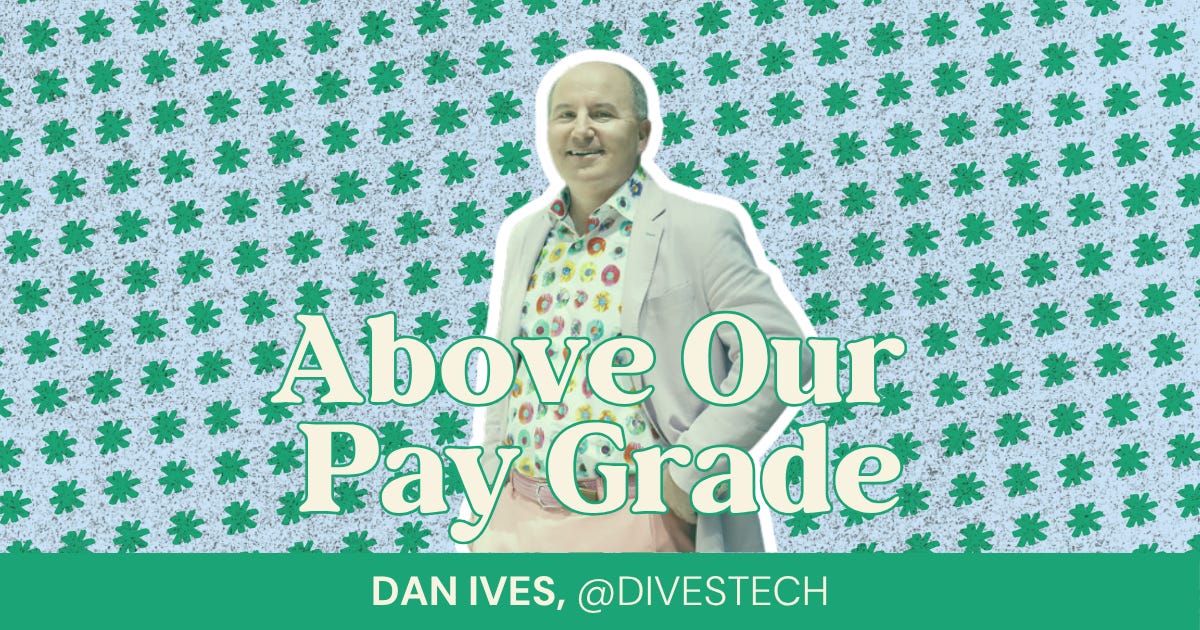
Now, he’s launched Yorkville Ives, a modern merchant banking system aimed at where all of this goes next. He also lives around the corner from us—close enough that our internet runs down the same New Jersey cable—which means I get the version of Dan you don’t see on TV.
Usually, we talk about AI through the lens of markets and price targets. This time, I wanted the opposite. I wanted to pick his brain on the stuff that actually runs our lives: our kids, our marriages, and the invisible logistics of a household. What follows are highlights from our conversation, edited for length and clarity:
Douglas: Everyone has been told AI is going to change everything, but most people still use it to write an email or settle an argument at the dinner table. What are the real everyday ways a normal family should be using AI right now that would actually make their week easier?
Dan Ives: Great question. Look at what Apple is doing right now. The average person has an iPhone, and with Apple leaning into AI, you are going to have hundreds of apps over the next 12 to 18 months that are AI focused: healthcare, financial, fitness. Today most people are using ChatGPT or Claude, but you are going to start seeing it everywhere in everyday life, whether it’s for cooking dinner, health, or fitness. My view is to embrace it wherever it fits your family’s lifestyle. It is going to become much more of an everyday thing, and it can be done in a healthy way.
Doug: So much of what we do comes back to the kids. You’re a dad; I’m a dad. And as parents, we’re getting whipsawed. One headline says AI will rot our kids’ ability to think on their own. The next says they’ll be unemployable without it. What should our kids actually be doing with AI, and what does a healthy relationship with it look like at their age?
Dan: “Healthy” is the right word for it. You have to embrace it, because it is going to be a skill set no different from Excel. Anywhere you go in the workforce, you will need it. But healthy matters, especially for younger people. From a cognitive perspective, if you lean on it too much, especially around school, that can go in a negative direction.
The positive is that the jobs of the future are going to require it. Wall Street, an RIA, real estate, marketing, accounting. The goal is to actually understand it and have it as a real skill rather than a shortcut to get things done. There are also a lot of bad actors and cybersecurity risks out there. It is no different from a smartphone. As a parent you cannot just sit there and not watch. You have to pay attention to how your kids are using it and at what age.
Doug: I just started building agents for specific projects, and it's unlocking this whole organizational function for us. I'd love our kids to understand that yes, you can get lost in the sauce with anything internet-based (like you see kids rot their brains on social media), but you can also use these tools to get organized. I'd love my oldest to build an agent that runs her school week. She's a lot like her dad, and I think she'd thrive with it.
Dan: If it’s used in a healthy way, AI can keep kids more organized, even from a cognitive perspective. The problem is when it is used just to cheat on tasks.
Doug: “Write my paper for me.” That’s the throwaway.
Dan: That’s the real concern. You hear the leaders, whether it’s Dario at Anthropic or people at Microsoft, talk about the threat of wiping out jobs. But my view is that no technology in the last hundred years has been a net job detractor. For the first time in thirty years, the U.S. is ahead of China on tech, and I believe AI will create more jobs than it takes away, even if certain areas get hit.
The goal is to actually understand it and have it as a real skill rather than a shortcut to get things done. - Dan Ives
Doug: I’m shocked no one has shipped a real kid version of these models yet. Not something that does the homework, but something you feed the school day into. My girls could come home and say, “Here’s what I have going on. Help me organize my afternoon. Will I have time to ride bikes with my friends?” And they wouldn’t even type, they’d just talk to it.
Dan: For a second or third grader today, that will probably happen by the time they are in middle school. A lot of it comes down to regulatory approval in the school systems. It is going to have to become part of the curriculum.
Doug: We just ran an Above Our Pay Grade on the invisible labor that piles up in a household, and this is also a big part of Money Together: the appointments, the carpools, all the mental load that nobody sees. Is AI actually good for this yet, and where should families let it into the day-to-day?
Dan: You can use AI, from an agent perspective, almost as a chief of staff or an administrator. This is the healthy way to use it, whether for sports, appointments, organization, or family obligations. This is going to sound like the Jetsons, but a lot of it is real: over the next four or five years, and especially the next decade, robotics will show up in more households as price points come down. If you have a teenager today, by the time they are in their twenties, coming downstairs to some robotic help around the house is going to be a reality.
Doug: This is a money newsletter, so I have to ask. Let’s go beyond the ticker symbols. How is AI already changing the finances of an average household, and is there anything people should be doing with it around their money today?
Dan: It has already changed the investing climate. A big part of this bull market is tied to AI and tech, so it has affected portfolios and how people think about risk allocation. But on an everyday level, AI can help a household find where to save, and give you much more of a dashboard view of where your money is going. AI agents are becoming more and more important in financial planning. This is not something to hide under the covers from. It is going to become more and more a part of everyday life.
Doug: You are great at seeing around corners, Dan. In the next year or two, what should families have on their radar? I’m talking scams, deepfakes, hazardous stuff, but also the good things coming fast that most people aren’t ready for?
Dan: There are real hazards. Deepfake scams, even voice-based ones, are going to grow as AI spreads. But on the positive side, U.S. productivity is going to increase massively because of AI, and that drives a real innovation boom. I think one in every four or five cars is going to be autonomous over the next few years. Robotics is going to be a key piece. And you are going to see AI show up in apps and in healthcare. I believe in drug discovery especially. When you think about Parkinson’s, dementia, cancer, we haven’t had a true cure since polio, and this could actually be the thing that cures one of these diseases. So this is not just about your electricity bill going up or AI taking your job.
Doug: What’s the most overhyped part of AI right now, and what’s the thing you’re genuinely excited about for families like ours?
Dan: The most overhyped are the models themselves and some of the open-source stuff, especially what we see out of China and Asia. The real value is going to be in the data; not the models. From an investing perspective, it’s much more about the chips, the software, and the infrastructure layer, the Nvidias of the world. As for what excites me, there is so much here, not just the innovation but what it does for the average consumer. It levels the playing field. You can graduate from college and start a company without needing twenty million dollars in seed funding, because so much of the engineering is built into these models. It’s an innovation boom, and it’s happening here.
Thank you so much to Dan Ives for helping us go Above Our Pay Grade. Keep an eye on what he’s building next, and if you take one thing from this conversation, make it the same thing he tells college kids: learn to use these tools now in a healthy way, and you’ll be better for it.
How are you using AI in your everyday life? Have you introduced it to your kids yet? Let’s talk about it, and if you have anyone you’d like to hear from in our next edition of Above Our Pay Grade, let us know.


If you don’t know how much we love apocalyptic television, now you know. Without question, Season 3 of Silo on AppleTV just had the greatest end-of-season-finale arc out of all of them. We don’t want to spoil anything, so we’ll keep it high level. But Daniel and Helen, keep fighting the good fight—that is, when you remember.

Want to go deeper? Money Together is everything we’ve learned about love and money, told through real stories with lessons for people who want to build a financial life together without losing themselves in the process. Order your copy on: Amazon, Barnes & Noble, Bookshop, or Audible (narrated by Heather!).
Love it already? A review on Goodreads and wherever you purchased helps other couples find us and means more than you know.
Bring us to your organization! We speak on money, relationships, and what it really takes to build a financial partnership that lasts. Available for corporate events, conferences, and private engagements — virtually and IRL. Reach us here.
Connect with us on social: @averagejoelle + Douglas A. Boneparth
The content shared in The Joint Account does not constitute financial, legal, or any other professional advice. Readers should consult with their respective professionals for specific advice tailored to their situation. The information contained in this post is general in nature and for informational purposes only. It should not be considered as investment advice or as a recommendation of any particular strategy or investment product. This post is not a solicitation or an offer to buy or sell any specific security. Bone Fide Wealth cannot guarantee the accuracy of information from third parties.
Season three finale of silo has me committed to read all three of the books. Was fire.