
How can we save for a moving target?
Welcome to our first One Big Thing: how much we're saving for college (right now).

Hey, it’s Doug. Has winter been cold enough for you? (Stay out of this, my Floridians.)
I’m very excited to introduce you to another new series from The Joint Account. We’re calling it One Big Thing, and it’s probably the most personal material we’ve ever offered you here. Every quarter, we are going to share with you one meaningful change we’re making to our financial lives, and why we’re making it.
If you’re wondering why every quarter, that’s how often we hold our scheduled money meetings. Heather and I try our best to practice what we preach. We want to show you where we’re getting it right, where we’re getting it wrong, and where we’re not quite sure so we’re testing the waters with something new. In our book, we share whole lot about our lives, because it’s meaningful to see someone else go first. Consider this an extension of that, and hopefully, the start of some incredibly meaningful conversations.
So, here’s our first One Big Thing.
For the past several years, we’ve been contributing $450 per month to each of our daughters’ 529 plans. The number wasn’t random. It was the number that felt doable and responsible at the time for us to meaningfully save toward their college educations. But during our year-end money meeting, Heather and I admitted to each other that even for a financial goal with so many unknowns, their college savings felt a little lighter than we’d like. So, we made a simple change by increasing contributions to $650 per month, per kid.
Importantly, we can afford to increase without derailing our other financial goals. Though we can’t predict the schools, costs, or paths our daughters will take, we just want to know that they will have options to work with. Heather and I are aligned on the fact that we don’t feel compelled to hand our kids over a blank check for college, but beyond that, there’s a lot of blanks we can’t fill in.
Flexibility is the key.
You know that I’m a financial planner. I like building models, mapping out scenarios, working the numbers, and finding answers. And yet, when it comes to college planning, it’s still one of the hardest financial goals to solve for. When people ask me, “How much should I save for our kids’ college education?” what I honestly hear is, “How do I make a plan for something I can’t see clearly yet?”
To pressure-test the decision, I ran projections on the cost of a four-year degree based on blended averages across public and private, and in-state and out-of-state tuitions. I landed around $35,000-to-$38,000 per year as a planning range. When solving for what we would need to save each month to make this goal a reality, I used a 4% inflation rate, and a 6% rate of return (for those of you interested in my math). Is this what our kids will pay? No clue. That’s the point. It’s not a forecast—it’s a reference range, and a way for us to check whether we’re building options or if we’re living in denial.
Math is easy. A moving set of assumptions is hard.
Right now, Hazel and Ruby are 10 and almost 7. If they take the traditional four-year college route, they will graduate 12 and 15 years from now. The only thing we know about what will happen 12-to-15 years from now, is that we don’t know. The costs of higher education, the economy, the labor environment, our own financial situation, and our evolving beliefs about the role parents have in jumpstarting their children’s adult lives…these are all living, breathing concepts. We can hypothesize (and I will for a moment now), but we just don’t know.
Heather and I have been questioning the ROI on higher education for years. In our first book, The Millennial Money Fix, we explained how the trillion-dollar student loan debt bubble built a perfect storm through the college marketing machine duping families into believing everyone deserves to be at their universities of choice, studying down their niche rabbit holes of choice, by offering them unfettered access to student loans (many of them private at high interest rates) to enable them to do it.
That was in 2017. We thought, it can’t possibly stay like this, and it’s true that we’re seeing marginal change. According to the latest findings from the Education Data Initiative, tuition inflation slowed in the 2020s, but still, the overall tuition costs have increased 36.8% since 2010. In terms of enrollment—and we find this very interesting—you’ve got community college to thank for growth in the sector. The National Student Clearinghouse reports that last fall, a 1.2% growth in undergraduate student enrollment was largely driven by a 3.0% increase in community college enrollment, along with a 1.4% uptick at 4-year public institutions. Enrollment decreased at private institutions.
I’m painting with broad strokes here, but maybe the “value grift” is starting to show its true colors, and we’ll see a meaningful shift in public sentiment by the time our daughters have their own decisions to make.
In terms of the labor environment, who knows. Somewhere, there is an AI chatbot training to take our daughters’ entry-level jobs. Heather thinks we’re over-relying on AI to replace human capital in certain sectors and functions; but clearly, we’re just beginning to understand what an employment landscape that fully incorporates AI will look like, and how people will actually earn money once it does. Maybe this will push more young people back into vocational and trade work. But my point is, again, we are too far out from that moment in our lives to waste much time guessing about it.
Then, of course, we have to consider how we’ll feel as parents. In Money Together, we write about parenthood as only knowing what you know. I think it’s hysterical when people without kids pass judgment on how parents treat bedtime, screen time, or public etiquette, when they’ve never experienced it themselves. Heather and I have thought we’d handle things a certain way only to learn when the moment arrives that we were totally clueless about the reality of the situation.
Right now, we both agree that we want our girls to have financial “skin in the game” for college. We met at a public university, where we had some of the best times of our lives. We want our kids to create those moments, too, but we also both worked our asses off in and out of the classroom. We both earned money throughout school. We don’t think we’d be doing the girls any favors by perpetuating a message that four years of studying, say, The Classics on our dime would set them up for a lifetime of prosperity just because they were interested in it. Or that being a mediocre student without much drive warrants us paying for an exorbitant private education at a low-tier university just so they can “go somewhere” and “experience something.” Our values tell us otherwise.
But we’d be lying to ourselves to think this all can’t change. For example, would we really have our children take on student loan debt if: (a) one of our daughters is a literal genius who wants to become a mechanical engineer at an Ivy league school; (b) we are in a financial position to pay for it; and (c) what about the other child? Can you really give to one and not the other? On the other hand, an Ivy-league-caliber student could ostensibly get a full-ride to our public alma mater, and we could all ride off into the swampy sunset.
My point is…we only know what we know. We are not so arrogant to believe we know much more than that.
With a goal as uncertain as college, we’re not trying to chase certainty. We’re trying to buy flexibility.
We want as many levers as possible for when the future arrives. While we know we want to cover a meaningful portion of the cost, we still want to leave ourselves enough room to make smart choices in real time. From choices about the school itself and how much we’re willing to stretch ourselves financially, to what’s reasonable to expect our kids to contribute and what we’re not willing to compromise in our own financial lives.
And if you’re thinking of increasing your own 529 plan contributions, start smaller than you think you’re comfortable with. Consistency beats intensity. If don’t think you can sustain $200, increase by $50. Automate it, so it doesn’t compete with other decisions.
Then revisit when your life changes: getting promoted or finding a new job. No longer needing paid childcare. Paying off your own student loan debt. These are the moments when you might reevaluate whether you should do more.
In the end, college isn’t the ultimate goal we’re saving for. We just want to give our children the best shot to thrive as adults in an ever-changing world.
Parents with younger kids: what your plan? How are you thinking about college savings for your kids? Let’s talk about it.
We Reddit online

Okay. I believe most bonuses should be allocated toward your joint financial goals, but you can’t ignore what they actually represent. As I wrote last month, bonuses aren’t just numbers. They’re a recognition of your efforts. A tangible “you did it.” So, if one partner’s first instinct is to toss both bonuses straight into the shared pot without acknowledging what they mean? Yeah. That’s not fair. It sounds like they’ve built a solid system for monthly expenses (for now), but bonuses really do live in the gray.
Here’s what I’d try. First, celebrate the win. Before splitting anything, acknowledge the bonus for what it is. Go to dinner. Take a weekend. Buy something you’ve had your eye on. Doesn’t need to be wild. It just needs to say, “This mattered.” Then, talk about your shared goals. What do you want to build together? Bigger emergency fund? First home? Career cushion? Once you’ve aligned on that, you can allocate what’s left with intention. -Douglas
Out and about!
Already, it’s been a busy month. We celebrated the relaunch of The Purse (congrats, Lindsey Stanberry!) - and if you’re not subscribed yet, it’s only getting better, so don’t wait. Catching up with friends in financial media was just what we needed to push through another arctic blast: The Point | Rachel Lipson, Erin Lowry, Charlotte Cowles, Stefanie O'Connell, and more we can’t tag :) Good times. Thanks again to The Purse for giving us good reason to gather.
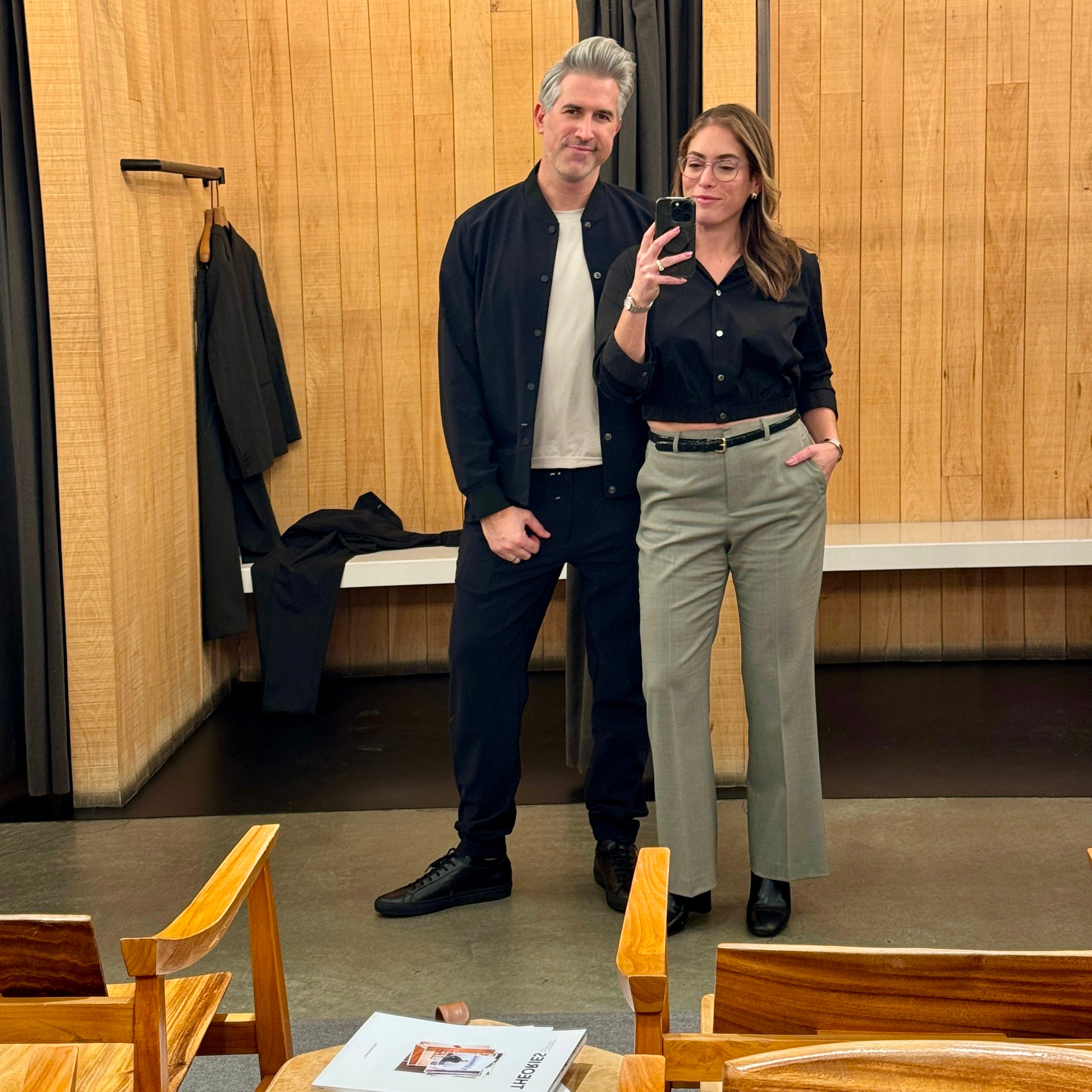
We also hosted a lil shop and sip at Theory in the city. Thank you to the friends, colleagues, and clients who braved the giant snirt (snow+dirt) mountains to spend time with us after work.
We also joined Kanika Chadda-Gupta on her podcast, That’s Total Mom Sense, for an enlightening conversation on money, parenting, responsibility, and values. We’d REALLY like to talk more in the parenting space, so if you have any ideas or colleagues to connect us with…let us know!
Volatility’s the theme this week, as Douglas spoke with CNBC about tech, AI, and Bitcoin’s fall.
HWYS?
Your response to our first one was awesome, so let’s up the ante.
For our next How Would You Spend, the amount is: $1,000. HWYS $1,000?

Money Together is here! Order now in your format of choice.
Love it already? Leave us a review wherever you purchased!
Want more Heather and Doug? Have us come talk love and money for your organization—virtually or IRL. Reach us here.
Connect with us on social: @averagejoelle + @dougboneparth
The content shared in The Joint Account does not constitute financial, legal, or any other professional advice. Readers should consult with their respective professionals for specific advice tailored to their situation. The information contained in this post is general in nature and for informational purposes only. It should not be considered as investment advice or as a recommendation of any particular strategy or investment product. This post is not a solicitation or an offer to buy or sell any specific security. Bone Fide Wealth cannot guarantee the accuracy of information from third parties.
So fun seeing you both. And the Theory looks are on point!
It was so great seeing you both!! This also got me thinking that I need to up my game with a 529 Plan...