

Last month, The Skimm challenged me to answer a tough question in 200 words. It was about bill splitting etiquette when your friend loses her appetite from being on a GLP-1. Technically, I knew the right things to say: communicate, see the big picture, don’t lose a friend over a bill! But in even posing my bite-sized advice on social media, people lost their minds. My DMs turned into red-hot lava fire. Everyone had an opinion spanning far beyond the original question.
Right away, I could tell this had nothing to do with etiquette. It was about what happens when someone you love starts to change.
I spoke with Rachel Goldman, PhD, clinical psychologist and author of When Life Happens, about what’s really going on here. She told me that “relationships exist within a system, so when one person changes, the dynamic often changes, too.”
Now, your gut reaction might be the same as mine. I thought, even in the case of close friends, someone else’s body and lifestyle choices are not really our business, so beyond an acute bill-splitting issue, there’s nothing more for us to say or feel. And yet, we all know that’s not really the end of the story. We whisper. We vent to the wrong people. Frankly, we project. Even when someone’s evolution is objectively good for them, you still might not know how to feel. This is the side of human behavior that’s not only difficult to talk about but makes relationships hard to sustain.
Don’t worry about over-moralizing. Just consider it all data.
“You can feel happy for someone AND simultaneously feel sad, left behind, uncertain, or even jealous,” Dr. Rachel said.
To some extent, we are all creatures of comparison. We cannot help but view the decisions and happenings of our loved ones as a mirror back onto the decisions and happenings in our own lives. We wrestle with why we have not, or could not, or would not. Maybe we would. Maybe we had never thought about it, until we saw them go first.
We also begin to worry that someone who held a certain place in our lives may no longer fit there. “Our brains generally prefer predictability, so any shift, even a positive one, can trigger these feelings,” Dr. Rachel said. “All situations are neutral until we interpret them.”
No, we are no longer talking about a restaurant bill.
Behind all the hissing in my DMs, I understood there to be a deeper outcry. It felt painfully familiar to me as someone who regrets casting negativity upon people I cared about AND as someone who intimately knows what it feels like to have friends drift away. They are really saying:
How dare you change without my permission? How dare you leave me behind?
“Two people can watch the exact same friend get engaged, have a baby, lose weight, get a promotion, or move away. One person feels inspired, and another feels threatened. The event isn’t what determines our emotional response. It’s the meaning, or the interpretation, we assign to it.” - Dr. Rachel
Many people experience this the hardest as young adults. For the first time, you’re no longer tracking milestones alongside your peers. You don’t just graduate onto the next phase of life together. You’re moving forward, sideways, and standing still . . . sometimes all alone. I moved to New York City with tons of good friends from college, but I went to law school while many of them started their first jobs. For a while, we didn’t see eye to eye—I was phantom human working around the clock for the chance to find work, while they navigated adult pressures, workplace politics, and low starting salaries. Looking back, I know I took it out on everyone, but I don’t think I was angry with them. I think I was scared for myself. But I also can think of times when a friend took change out on me: when I got a better job; when I moved into a great apartment with Doug; when I got pregnant with our first child.
We’ve all lost people moving through big transitions. Especially when you’re young, it can be hard to access the emotional maturity to untether a friendship from the shared experience of it. Not at a time when you might need those shared moments to confirm you’re doing things right.
It made sense then, but what about now?
As of this summer, I’ve been living in the suburbs for a decade. My husband and I have built a life around our children, our profession, our culture, and our individual interests. Most of those stereotypical adult milestones are far in our rearview mirror, so I thought we’d reached cruising altitude and could float through the season without falling out of orbit from people we care about.
I should have known that midlife has its own set of transformations.
Here you are, thinking you’ve arrived. You know who your people are and what you’re all about. And then, a friend gets sober. Someone loses 100 pounds. Someone leaves a 15-year marriage. Someone sells their business and gets rich.
The big things never stop coming. Because of that, life will keep introducing us to new versions of the people we thought we already knew.
The key is recognizing that the personal meaning we assign these changes is ours. Not theirs. Dr. Rachel suggests that “instead of assuming the other person has done something wrong, ask yourself, ‘What is this emotion trying to tell me?’”
You might realize you’ve got something to process on your own rather than a problem with someone else.
But if you sense the distance between you is real, you might want to address it. Just proceed with caution and be sure you’re clear on the reasons why you’re doing it. Dr. Rachel says you don’t want to make someone feel guilty or responsible for your emotions. But if you need that reassurance or want them to really understand your experience, there’s a way to approach it. She gave me three examples of what to say:
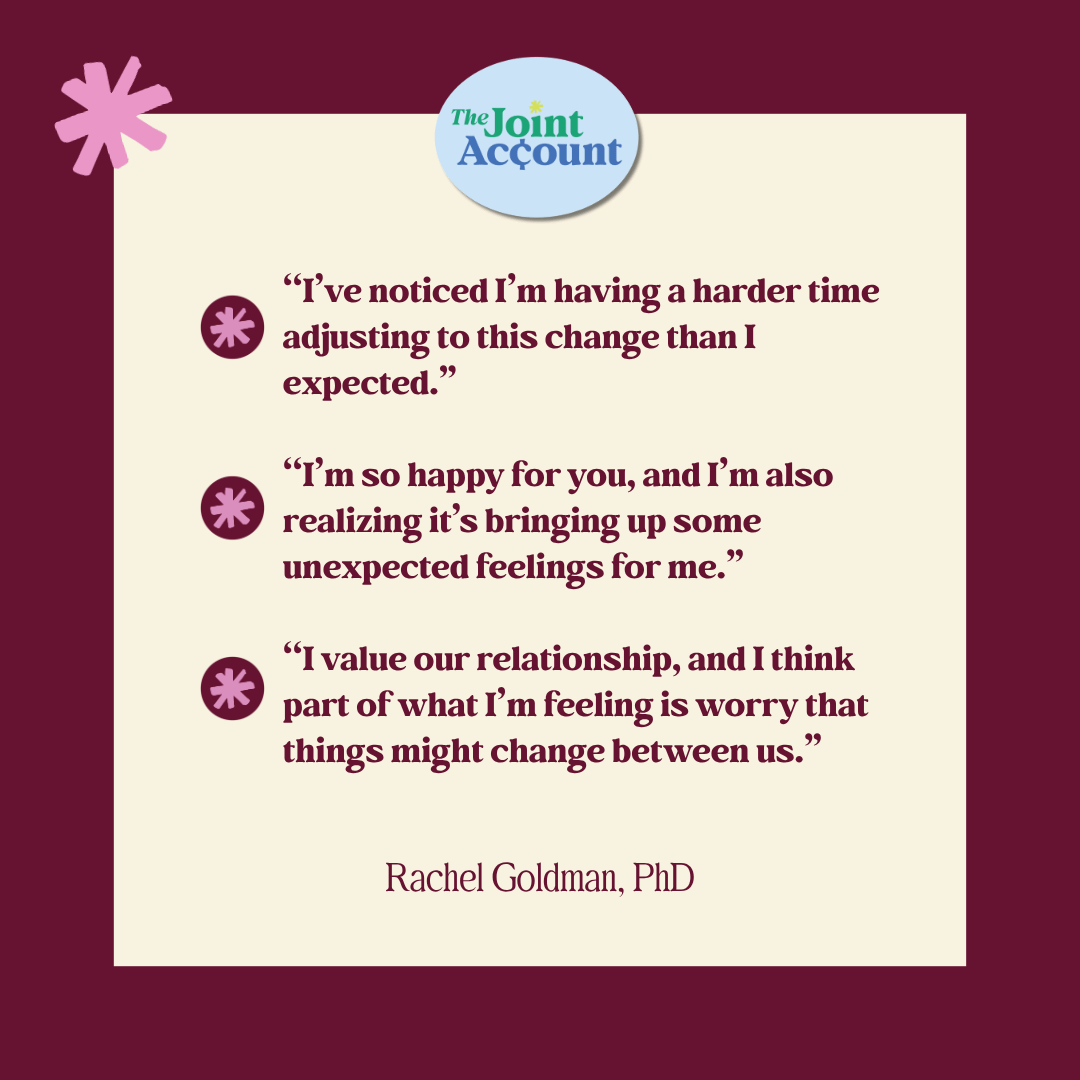
Statements like these welcome connection rather than pushing someone you care about back on their heels.
The reality is that friendships, like all relationships, change. They evolve with whatever else we have going on in our lives, and that might mean growing apart. But that does not mean you need to put a period at the end of your sentence together.
In fact, maybe this is what friendship really asks of us in adulthood. Not that we stay the same or occupy the same space in each other’s lives with stellar consistency, but that we are supportive enough to leave the door open for someone to walk back through it with a new look, new perspective, even a new life, and for us say, “I can’t wait to know you now.”
Have you ever felt confused about a friend’s life changing in some way? What happened next? We want to hear about it.
Thank you to Dr. Rachel Goldman for sharing her wonderful insights with us! Please order her fabulous book, When Life Happens: The Mindset Shift You Need to Manage Stress, Build Confidence, and Break Free.

You up? Good, because we’ve got a question for you. This mini-series mixes prompts from Money Together with fresh ones we’ve been thinking about, all designed to spark real, honest money conversations with your partner. Here’s one:


For CNBC Make It, we explained why Gen Z is rethinking the role of marriage in their American Dream. Our take? Treating your finances as a team still matters, regardless of when (or whether) you get married.
Doug broke town Trump Accounts for CNBC, and how families can weigh their options on where to invest for their children. (More on them here).
I appeared in The Purse’s mid-year check-in, offering my thoughts on the accounts and systems that are worth a quick peek now that we’re halfway through the year.

Want to go deeper? Money Together is everything we’ve learned about love and money, told through real stories with lessons for people who want to build a financial life together without losing themselves in the process. Order your copy on: Amazon, Barnes & Noble, Bookshop, or Audible (narrated by Heather!).
Love it already? A review on Goodreads and wherever you purchased helps other couples find us and means more than you know.
Bring us to your organization! We speak on money, relationships, and what it really takes to build a financial partnership that lasts. Available for corporate events, conferences, and private engagements — virtually and IRL. Reach us here.
Connect with us on social: @averagejoelle + @dougboneparth
The content shared in The Joint Account does not constitute financial, legal, or any other professional advice. Readers should consult with their respective professionals for specific advice tailored to their situation. The information contained in this post is general in nature and for informational purposes only. It should not be considered as investment advice or as a recommendation of any particular strategy or investment product. This post is not a solicitation or an offer to buy or sell any specific security. Bone Fide Wealth cannot guarantee the accuracy of information from third parties.
Everything you say is true, but the drugs have a unique effect on some people — and I do NOT mean the ones losing weight!
I have lost nearly 90 pounds and am much healthier now. I’m a cheerleader for how helpful these drugs are. And what I see, over and over, is that some naturally thin people are really angry about these drugs. Irrationally angry! Tell them these drugs normalized your blood sugar, blood pressure etc, and they’ll tell you that’s great but you’re going to get thyroid cancer or go blind. Tell them you’ve reached a healthy weight and they’ll insist you cheated. I could go on. Some people are vicious.
This brings us to our common interest, money. I touched on it in yesterday’s meritocracy piece. There’s a lot of indignant reaction about privilege from those who have it who insist they earned everything they have. Usually, they did in fact work hard — their hard work just went further.
Naturally thin people (usually) still refrain from gorging themselves. They think of all the times they declined dessert and believe they deserve to be thin. Then along comes someone like me, supposedly cheating my way to a healthy weight. You cannot convince them I haven’t been eating Big Macs and cheesecake at every meal. They don’t believe I was eating a really balanced diet. You cannot convince them the fat person was working hard but could not fight their biology.
They feel threatened and angry that they put forth “so much effort” and a “careless” person came along and got everything they did.
Excellent points.