


Heather here, back this week to talk about my husban-I mean, the ways we communicate :)
Talking about money is very hard, especially if you learned from an early age that doing it was inappropriate, awkward, or not even your place in a relationship. But finding the courage to communicate is only the first hurdle.
How we communicate can be an equal challenge.
Doug and I talk a lot about creating the right environment for productive conversations. We always say that time and place matter. So does intentionally carving out that time and making it as free from distractions and stress as your life allows. These things seem obvious, even though they have a way of slipping away from us in the midst of our noisy lives. But there’s even more we should be asking ourselves.
How does your partner receive information? Are you communicating in a way that actually works for them, or in the way you think should work for them?
I’ll explain how this played out for us.
Doug has some executive functioning quirks. Sometimes, I can tell that he’s dialed into what I’m saying. Other times, he is literally like Homer Simpson with a circus bear driving a small car around his brain. Most of the time, he swears he’s listening, but I am watching him finish an email or reply to a social media post, and I just don’t have the confidence that he will digest the information.

This gray area has led me to a lot of “I told you about this six times!” and “I really can’t believe you!” over the years, which I’m not particularly proud of. Even worse is where it leaves him: on his heels and unaware of something he should be clued in on, scrambling to rework his schedule, and just plain frazzled. When our wires get crossed like this, we all lose. I’m frustrated and he feels ashamed because this isn’t a new problem for him. It’s been a lifelong struggle.
Somewhere in the mess of recognizing that we had a communication problem, I found myself asking Doug, “What can we do to make sure you remember this?”
His answer was simple: “Email me.”
Doug’s inbox is like his treatise. His lifeline. In ways I will never understand, he is an Inbox Zero Guy. An Immediate Reply Guy. What goes into Doug’s work email does not go missing. It gets handled.
But I didn’t want to do it. As married business partners, we live a kind of unique life. Something about emailing him our personal to-do lists felt secretarial. As his wife, the formality of it insulted me. I should be able to mention something to my husband, and he should be able to do it. Shouldn’t he?
The cycle continued: me standing on my principles and him forgetting things.
Depending on what’s going on in your life, you can skirt by in dysfunction for a long time. But something Doug tells our client couples rang true for us, too: When life gets too hectic and hard, whatever is simmering under the surface will bubble over. It almost always does. In our case, it wasn’t one busy day but an entire busy year of book touring, firm growth, kid transitions, and too many things. Eventually, there came a day when I didn’t have just one action item for Doug but a full list. Enough to fill an email.
So, out of desperation, I sent one.
Would you believe that he got every single thing done that very same day?
I started thinking about my original objection to the whole thing. I had been focused only on what I wanted or didn’t want to do. But as the person receiving information, he was telling me that my way wasn’t working for him. Didn’t I at least owe him the flexibility to try?
In Money Together, we wrote an entire chapter about our preconceived notions of “normal.” The truth is that there is no normal. Our brains work in their own particular ways, and a method that reaches one person may be entirely ineffective for someone else. An advisor we interviewed for the book had spent years trying to explain their personal finances to his wife, a super-intelligent, highly motivated woman with ADHD, but nothing he said was registering. Then one day, he walked over to a whiteboard and drew out everything he was trying to get across to her. Suddenly, it began to click.
The material didn’t need to change, but the delivery did. His wife was able to digest more about their money, and they could work better as a financial team. Even more so, she began to build confidence around it. Understanding their money became one less thing she felt she should be able to do a certin way.
Doug doesn’t ask me to email him because he wants to make me responsible for one more thing in our lives. He’s asking because this is the way he can reliably receive and retain the information. We both want the same thing, and it’s both of our responsibilities to get us there. This really is not some productivity hack. It’s an act of love.
To be clear, accommodating the way your partner processes information doesn’t mean assuming responsibility for everything that happens next.
I can send an email. Doug still has to own what’s in it.
But as a first step, if we truly want to reduce the friction in the way we communicate, we have to be willing to consider how the other person operates. It’s the quintessential demonstration of meeting your partner where they are.
Has talking to your partner ever felt like talking to a brick wall? How did you bust through it? Let us know!

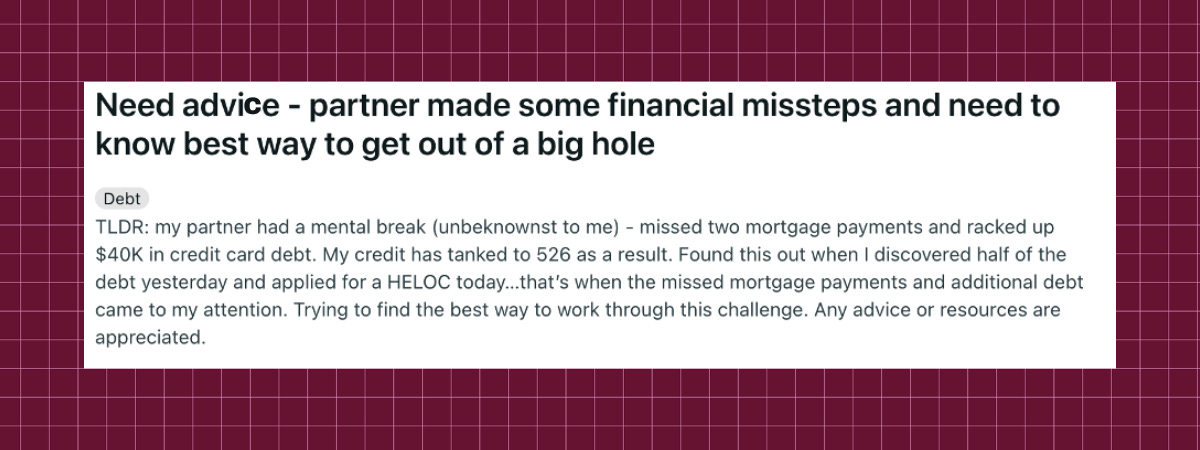
Take a breath. What you found out is scary but fixable, and you caught it early.
The mortgage is the fire. Credit card debt is painful, but missed mortgage payments are what could ultimately cost you the house. Call your servicer today. Tell them you missed two payments and ask about reinstatement, a repayment plan, or forbearance. They deal with this constantly and would rather work it out than start the foreclosure process.
Maybe pump the brakes on the HELOC. At a 526 credit score with two recent misses, the terms would be rough, if you get approved at all. The bigger issue here is a HELOC turns unsecured card debt into debt secured by your home. Right now, that $40K of outstanding debt can’t take your house. If you move it onto a HELOC, it could.
If the recent financial problems you’ve discovered are a manifestation of your partner’s mental health struggles, that’s the part that matters most here. Make sure they, and you, are getting the real support you need from qualified professionals. -Douglas

Want to go deeper? Money Together is everything we’ve learned about love and money, told through real stories with lessons for people who want to build a financial life together without losing themselves in the process. Order your copy on: Amazon, Barnes & Noble, Bookshop, or Audible (narrated by Heather!).
Love it already? A review on Goodreads and wherever you purchased helps other couples find us and means more than you know.
Bring us to your organization! We speak on money, relationships, and what it really takes to build a financial partnership that lasts. Available for corporate events, conferences, and private engagements — virtually and IRL. Reach us here.
Connect with us on social: @averagejoelle + @dougboneparth
The content shared in The Joint Account does not constitute financial, legal, or any other professional advice. Readers should consult with their respective professionals for specific advice tailored to their situation. The information contained in this post is general in nature and for informational purposes only. It should not be considered as investment advice or as a recommendation of any particular strategy or investment product. This post is not a solicitation or an offer to buy or sell any specific security. Bone Fide Wealth cannot guarantee the accuracy of information from third parties.